Story versus Style

What’s more important – that a book is well written or that it has an engaging story? I’ve always been firmly on the side of story. If the story isn’t compelling then it surely doesn’t matter how beautifully it’s been written. That’s what I’ve always thought, at least. However, I am now reading a book that’s making me rethink my position. I managed to get my greedy fingers on not one, but two, of the titles for World Book Night, one of which was Love in the Time of Cholera by Gabriel Garcia Marquez. It is 348 pages and I am up to page 116, and I am completely and utterly gripped – not by the story, but by the writing. It is one of the most exquisitely written books I have ever come across – and I do consider myself to be pretty well read. There is an effortlessness in every sentence and I feel like this book is showing me just how great the written word can be.
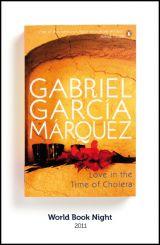
So far this year I have read a lot of just-released books, and have found many of them to be insipid and bland, and now that I am reading Marquez, those other books seem even more insubstantial and unsatisfying – like having a glass of water for dinner as opposed to a three course meal. Time of Cholera is something to really get your teeth into and, right now – just over 100 pages in – I feel like the book is nourishing my reader’s soul. I am not massively engaged with the characters or their story (although I suppose that could still change), but, with this book, it honestly doesn’t matter. I feel almost hungry for Marquez’s words. How refreshing to read a book that is not a fast-driven frenzy of activity from beginning to end. What a welcome change for there to not be some sort of fight scene or car chase on every page. This is a book that allows itself to breathe – and is all the better for it.

Pace is something I am painfully aware of with my own writing. I’m aware of a constant pressure to make sure the action doesn’t slow down, even for a second, in case – God forbid – the reader gets bored, and the reviewers begin baying for your blood etc etc. Surely we have not sunk so low as a society that all we want to see is pretty people running away from explosions? It is a notion that I dislike intensely. Not so much for Lex Trent or other comic fantasies because they’re naturally more fast-paced – but for serious adult books I find it very frustrating that there should be such a single-minded focus on grabbing the reader’s attention by doing the writing equivalent of bashing them over the head with a heavy object. Personally, I generally dislike books that start with action scenes or fights or chases. They bore me. If I don’t know the characters yet then I couldn’t care less what happens to them as they run madly through the house whilst being pursued by a werewolf/man with gun/love-sick sparkly vampire. Still, I am told that this is what most people want in an opening chapter.

In the story versus style debate I would hold up Dan Brown as a brilliant example of the former. I realise it’s dreadfully unfashionable of me to like Dan Brown, and many people (some of whom openly admit to having never even picked up one of his books) seem to almost fall over themselves in their eagerness to proclaim that the man cannot write, or that his writing style is clumsy at best. I do not accept this. I think Dan Brown is a very skilled and intelligent thriller writer, and no aspirations to literary snobbery will make me say otherwise. Dan Brown does not write beautifully but the stories he tells do not require that he should. I enjoyed The Da Vinci Code but I absolutely loved The Lost Symbol. I devoured it because every time I got to the end of a chapter I couldn’t wait to learn what was going to happen next. It gripped me very differently from the way Time of Cholera is gripping me now.

I am in awe of Marquez’s writing – literally, I am in awe of him – but I’m still more likely to take a Dan Brown book on holiday with me, or reread a Dan Brown book, or rush to the cinema to see a film adaptation. I am still more likely to eagerly seek out other work of Brown’s that I have not yet read – not because I think his books are better than Marquez’s but because, for me, story is still more important than style. I read Brown’s books – and others like them – for a different reason. Fundamentally, I read those books to enjoy them as a reader, whereas a book like Love in the Time of Cholera I’m reading mainly as something to aspire to as a writer – a fondly nurtured dream that perhaps if one worked at it solidly for fifty years or more, one might become even half as good.

And now, as a post script to this post, for anyone who hasn’t heard about this yet, my good pal, and blogger extraordinaire, Amanda Rutter, along with several other very fine people, have organised and set up an auction in aid of the Red Cross Japanese Tsunami Appeal. I’d like to encourage you to head on over to http://genreforjapan.wordpress.com/ where you can bid on all manner of exciting things, including rare signed books, critiques from authors and the chance to have your name in an author’s upcoming book. There is some super exciting stuff up for grabs – and, as a genre fan, some of the lots have left my fingers itching to reach for my credit card. As an example, if you’d like to be a baddie who dies horribly, but has some great powers (and who wouldn’t?!), in my friend Suzanne McLeod’s upcoming Spellcrackers novel then go here http://genreforjapan.wordpress.com/2011/03/24/item-27-appearance-in-the-next-suzanne-mcleod-novel/ and place your bid. I’d bid on this myself if I hadn’t just donated to Japan Earthquake Animal Rescue and Support. Sadly, animals tend to get overlooked in natural disasters of this type but they are just as much in need of aid as their human counterparts. If I and my whole family were killed in an earthquake and my spoilt, pampered pets were left to fend for themselves I would hope to God that there would be someone there to help them. If you’d like to donate to their ongoing efforts on behalf of animals in Japan then you can do so here: http://japanearthquakeanimalrelief.chipin.com/japan-earthquake-animal-rescue-and-support/

Tags: , ,

Happy 2011!

Happy 2011, everyone! As one of my New Year’s resolutions I thought I should probably try to get back into blogging a bit more regularly. What with one thing and another, it fell by the wayside a bit last year. This year I shall try to do better.

So, the first post of 2011 shall be about writing spaces. This is inspired, in part, by the guest post my friend and writing pal, Jaine Fenn, recently did at Book Chick City (http://www.bookchickcity.com/2010/12/where-stories-are-made-with-science.html). I seriously covet Jaine’s writing space. It’s amazing. She actually climbs a ladder to get to it! That is hard core, any way you look at it.

I’m actually quite fussy when it comes to writing spaces. For one thing, the room has to be a sunny one. That’s why writing here didn’t work for me:

This is a building at the bottom of our garden that we call the stable because the woman who lived at the property before used to keep her horse there but, as you can see, it’s more of a giraffe house than anything (my suggestion that we take the opportunity to get a giraffe, or perhaps a llama, was met only with chilly silence). When I was twelve or so, the stable got all kitted out for me as a birthday present – new second floor, new window, new ladder – the works. I’d said I wanted it as a writing space (if I couldn’t have a pet llama, that is), and I used to take a notebook and a cat or two down there and try to work. Not wanting me to crash through the unstable floor to my tragic premature death, my parents wisely decided that a sturdy new floor was the way to go. But even with the new, bigger window, it was just too dark. And the dead woodlice were a problem too. I swear, no matter how many times I hoovered ‘em up, they just came right back – usually in the exact same places too, bizarrely enough. So I mainly filled the top floor of the stable up with Buffy posters and old rugs and coffee tables that people threw out. God only knows what it looks like up there now – I haven’t been in it for yonks.

So although I liked the idea of writing all alone in a little tucked away outbuilding, the dark-woodlouse-reality turned out to be a little different from what I had in mind. So I returned to my trusty old desk (that used to be my dressing table when I was a kid). When taking all the Christmas decorations down this year I decided (inspired by Jaine’s post) to really tidy up my desk and get rid of some of the clutter. As you can see, I failed fantastically:

Still, it’s less dusty than it was, at least. Some writers would probably find it distracting, but I don’t think I would work very well at a desk that wasn’t cluttered up with stuff. I did get rid of a couple of bits, but the things on my desk have come from all over the world, and I like seeing it all there. The lynx and the mummy came from Egypt, the lump of volcanic glass came from Italy (Mount Vesuvius), the mouse mat came from Budapest (Gerbeauds), the glass pink panther came from Venice, the little stone animals on the keyboard came from Washington (and inspired the Wishing Creatures of Desareth in Lex Trent), the storyteller ornament on the mouse mat came from Arizona, the little Viking came from Norway, the Lego wizard came from the Netherlands, the green mermaid on the wall came from some island in the Med (or possibly the Caribbean) that I can’t even remember the name of now. All right, so perhaps the Jesus and Albert Einstein action figures aren’t strictly necessary, but I like gliding Jesus across the desk (his wheels means he comes with gliding action!) and playing with Einstein’s hair when I get stuck with a book. Can you spot all those things I mentioned?! It’s like a Where’s Wally only without Wally. Where’s Writer’s Stuff, perhaps? You could have hours of fun with that, I’m sure.

I have photos of my grandparents and my favourite cat, who have all now passed away, as well as presents from various people. My little cousin bought me the brown cat, writing pal Suzanne McLeod gave me the little witch sitting on top of the speakers, Jaine Fenn gave me the black rose ring (next to the witch), and my Mum bought me the little brass desk-top Mephistopheles when The Ninth Circle was published. And obviously the book covers from my own books that I have propped up there are important because they make me feel more like a real writer when I sit down to work, rather than someone indulging a hobby – which is how it always feels, perhaps because I enjoy it so much.

So, there it is. My desk might look like a ten-year-old’s toy chest but, hey, it works for me. Perhaps one day, when I am a proper grown up, I might get me a nice big clean desk overlooking the sea or something. But the chances are I will probably just fill it up with more clutter, gifts, book covers, photos, and spoils from my various travels.

Tags:

The Age Question

I have been thinking recently about the question of age when it comes to writing. This is partly because of the podcasts I did at Alt Fiction which touched on the issue. Links below:

New Writers and Breaking in with Alex Bell, Kate Griffin and M D Lachlan: http://unboundblogzine.podbean.com/altfiction-new-writers-and-breaking-in/

Fantasy - The New Generation with Alex Bell, Kate Griffin and Mark C Newton: http://unboundblogzine.podbean.com/altfiction-fantasy-the-new-generation/

There’s also the fact that people increasingly ask me for advice about how to get published, which always makes me remember one spectacularly ludicrous piece of advice I once got. When I was fifteen I was really enjoying the work of a particular author (who shall remain nameless) and so I decided to write her a gushing email, telling her that I wanted to be an author one day as well. She sent me a very nice reply, which I was very chuffed to get, but in it she said that her advice about writing (I do not recall actually asking for any) was that I shouldn’t even try to write a book until I was at least forty. ‘I know that sounds hard,’ she said, ‘but you have to have stuff to write about.’

Eh? Stuff to write about? What nonsense is this? I remember being quite miffed by the suggestion that my age meant I was not qualified to write a novel, especially since the author knew nothing about me or what I had done, or where I had been, or what I had lived through.

I would expect anyone to become a better writer as they get older and more experienced – both at writing and at life – but I don’t think it’s as black and white as there being a fixed minimum age – not when everyone’s experience of life is so vastly different. Besides which, a lot of the authors I know got their first book deal before they were forty. But there is this idea that if you’re very young, you won’t be able to write a novel of any worth. I’ve realised that I’m even guilty of this prejudice myself. If I find out that a book was written by a teenager (Eragon, for example) I am instantly dubious about reading it, despite the fact that I was a teenager when I wrote my first published book. Hypocritical of me, I know but there it is - I ain’t perfect. It seems to be a sort of sliding scale, where everyone has their own idea of how old a writer has to be in order to write well.

But what is it that we think a writer should have experienced before they can start? Love seems to come up a lot. Does someone have to know what it’s like to fall in love before they can write a book? Do they have to know what it’s like to get their heart broken? Should they have had a near death experience? Should they have travelled all over the world? The travel requirement is often mentioned in The Waltons (yes, I do watch it, and I love it too). John-Boy wants to be a writer, but he believes he can’t be one whilst he’s living in the mountains. He thinks he has to move to a city and see more of the world. Is this true? I have been very lucky with how much I’ve travelled, and there is no doubt that those experiences have influenced my writing. But is it a necessity? I’m not sure. Imagination, after all, is the key part of writing a book. You can be a recluse sitting in a mountain hut and still have a fantastic imagination.

And that leads on to the other point that your characters are not you. Your experience of being in love, or travelling to remote places, or whatever, will not be the same as theirs. My characters do not react to things the same way that I do. Still, there can be no doubt that experiencing something yourself is going to aid the process of describing it. But that’s all it does – it helps. It is not essential. You do not need to cut off your own hand before you can imagine how it would hurt. And you know you’re taking the writing thing just a bit too seriously when you find yourself bemoaning the fact that you never broke any bones as a child (as a result of being the careful, bookish type) and so don’t know what it feels like for the character you’re writing. I was quite shocked to find myself looking at my hand and thinking: ‘Wouldn’t it be great if I could break a finger or something?’ – just so that I would have direct, first-hand experience of what it was like, and so could write about it better. Where did I put that hammer anyway . . . ?

I think my conclusion at the end of all this is that as you get older and experience different things, your writing should improve. But as for when it is legitimate to start, I would suggest that so long as you have experienced some form of happiness and some form of misery then you are qualified to write a book. The rest can be fleshed out using your imagination. We are writing works of fiction, after all, not the world’s dullest autobiography.

Tags:

Mr Darcy versus Mr Bingley

I’ve recently been reading Jessica Morrell’s Bullies, Bastards and Bitches, which is, ostensibly, about writing villains, but also discusses heroes, unsympathetic protagonists, dark heroes and bad boys. It’s a fantastic book, nicely set out, with some very interesting observations about characterisation, and I would highly recommend it to any aspiring (or, indeed, professional) writer. At one point it talks about alpha males and beta males and uses Mr Darcy as an example of the former, and Mr Bingley as an example of the latter. Morrell suggests that women want to marry a Mr Bingley but want to read, and fantasise about, Mr Darcy. It’s an interesting and, I think, accurate suggestion.

Mr Darcy – and most of the romantic male leads in the Madeleine Brent books – are, in some ways, anachronistic. Women do not depend on men in the same sort of way in the modern world, and marriage is not a woman’s sole preoccupation. When I studied A Level Sociology, we looked at articles from the 1950’s giving advice to wives and I remember being particularly horrified by a passage suggesting women take a nap shortly before their husbands were due to arrive home so that they would be suitably refreshed to receive him. They were then to change their dress, put a new ribbon in her hair, and greet the husband at the door with his slippers. In addition, they should not be the ones to instigate conversation because the husband has had a long day and might be tired etc. That being the case, the last thing he wants is a chattering wife bleating dull, domestic trivialities in his ear. Garghh! It’s just too awful! And only fifty years ago!

So, this is a problem with some male romantic leads like Mr Darcy. It might have been fine back then, but modern women do not want such over-bearing coddling. The feminist in me revolts against this character type.

And yet . . .

Who can deny that there is an appeal in spite of all this? I have recently watched the excellent Lost in Austen and am now re-watching the definitive Pride and Prejudice (of Mr Colin Firth renown), and I will admit that I am as much enamoured with Mr Darcy as the rest of the female audience/readership. I will also admit that I am an avid reader of the Madeleine Brent books, even though I feel they are something of a guilty pleasure. I feel I ought not to like them – being modern and all – but I am hooked regardless.

But much as I enjoy Darcy’s character in the book and TV adaptations, a real life version is really the very last thing I would want. And that is because, for me, a Darcy ceases to be interesting as soon as he professes his love. As soon as he does that, he is no longer cold and immovable but just another silly sap mooning after a woman. The book has to end with the marriage because nothing would be interesting after that. You want the characters to get to that point but have no interest in reading beyond it. Nobody likes gooey love, after all.

This is why I think that Jessica Morrell’s suggestion above is an accurate one. Marriage to Darcy may sound great on the face of it, but in reality? Surely one of the most important aspects of a relationship is that you are able to have fun with your partner. For example, I’m not sure that I could have a long-lasting relationship with a guy who refused to wear a silly hat at a Christmas party. There is always one whose vanity forbids it. And there is always one who collects the spare hats, and ends up wearing two, or even three silly hats all at the same time. The cold aloof Darcy routine is fine for creating mystique etc, but it might start to wear a little thin once you were actually married.

So although at first it seems quite odd to suggest that women might prefer one kind of man in dreams, and another in real life, I think there is definitely some truth to this. I don’t know if the same thing applies to male readers having an ideal female character in film/literature but quite a different ideal woman in real life. Presumably the same principle might apply, although I haven’t seen as much evidence of it.

I suppose the point is that characters like Mr Darcy drive the story more, so they are far more exciting and entertaining to read about. Characters like Mr Bingley (or, say, John-Boy Walton, or George Bailey), whilst being ideal husband material, are not exciting, so they do not get to take on the smouldering romantic roles in a book (or film). Perhaps the difference is that real life cannot be exciting all the time – and who would want it to be? As Morrell points out, alpha males are not going to be the types to stumble out of bed to see to the baby in the middle of the night, or clean out the cat tray – or, indeed, take great delight in wearing lots of silly hats at a party. And, much as I love Mr Darcy in the context of his own little fantasy world, in real life I would always rather be with the guy wearing three hats rather than the guy who is too far above himself to even pull a cracker with someone, let alone wear the paper hat inside it.

Tags: ,

I am a Writer. I think.

This is something I’ve come across in several different places, both online and in real life: when is it okay to call yourself a writer? It’s one of those weird labels that people seem strangely reluctant to claim, and I am no exception. When I was writing my first novel I hesitated to call myself a writer because I had not achieved any measure of success yet. I therefore felt that I did not deserve the title somehow. It seemed akin to announcing myself as a king simply because there was a Burger King crown on my head.

The problem is that with most professions you either are something, or you are not. There is no inbetween, no fuzzy grey area of uncertainty. Writing is different because it very often starts out as a private hobby, and there is certainly no qualification you are obliged to take before officially achieving the status of ‘Writer’. And therein lies the problem. You can call yourself a writer even if you’re a really bad writer, and you can call yourself a writer even if you’ve never written a single story. I don’t believe you have to be spectacularly talented to call yourself a writer but you probably should be writing something even if it is awful.

Before I got my first book published I more or less stopped telling people that I wanted to be an author because I got tired of the pitying, condescending looks I received in response.

‘It’s very difficult to get published,’ people who were in no way experts on the publishing industry would helpfully say to me. ‘Very difficult.’

Really?’ I replied. ‘I had no idea! Thank you for pointing that out to me . . . Seriously, though, how much of a naïve fool do you believe me to be?’

Or, at least, I would think that silently in my head, and out loud I would say, deadpan: ‘Yes. I have heard that.’

I thought that once I got my first book deal it would be easier to say: ‘I am a writer’ without turning red. But it wasn’t really. People still looked at me with pity or, worse, disbelief. It doesn’t help when a lot of people say they are writers when what they really mean is that they like the idea of being a writer and may give it a go if they ever have the time, but probably lack the discipline to even successfully complete a novella, never mind a novel.

I saw quite a lot of this at the writing group I joined at university. One guy in particular seemed excessively and never-endingly impressed with himself because he had been writing a ‘novel’ for the last three years, and had reached 10,000 words during that time. He had never written an actual full-length book, and yet he spent every one of our weekly meetings dishing out advice about how such a book should be written. He even attempted to advise me on more than one occasion despite the fact that I had a book deal by then. I felt like laughing, but everyone else looked so grave and impressed that I thought it best not to. Another bloke I knew insisted on referring to himself as a ‘poet’ even though he had written only one very short, and not very impressive, poem the whole time he was in the group. This is the literary equivalent of someone who calls themselves a vegetarian but, in fact, eats all meat as long as it’s not chicken. These people are the reason that when I refer to myself as a writer, most people take that as a euphemism for ‘unemployed layabout with high and mighty ideas of themselves’. The mind forms this image of someone trying to be all creative and arty and passionate and intense when, actually, they’re just a bit of a tit suffering from visions of grandeur.

I briefly tried ‘author’ and ‘novelist’ instead of ‘writer’ but those just sounded even more pretentious. Basically, I think if you are writing something then you are perfectly entitled to refer to yourself as a writer if you want to. Publication is not conclusive proof of worth (it just indicates that someone in the publishing industry liked your book, and thought it would sell), and non-publication does not mean that your work is shite. Literature is a subjective thing. That is why it is impossible to qualify. The Discword books would still be works of genius even if they had been rejected by every publishing house in existence. Even eventual popularity and sky-high sales figures are not concrete evidence of worth.

But, personally, I still hesitate to call myself a writer because people who’ve not seen/read my books still tend to react with either disbelief or condescension. I thought it would come easier once my first book was actually out on the shelves, but it didn’t. Indeed, although I have two published books out now, and two more that will be published in the next two years, I still feel uncomfortable referring to myself as a writer. I suppose it’s because I just tend to assume that I will not be believed. So many people claim to be writers (including those that do not write and probably never will) that it makes the title almost meaningless. The fact of wanting to be a writer does not turn you into one unless you actually do something about that desire. Just because you wish you were Captain Kirk, doesn’t mean you are Captain Kirk etc.

So although I certainly do consider myself to be a writer, I tend to skate over that when talking to new people, and only say vaguely that I am self-employed. That way I do not get pity or disbelief, and once they have gone I can still quietly whisper defiantly to myself: ‘I am King!’ or ‘I am Captain Kirk!’ Or something. But who knows, perhaps when I have written one hundred books, then I will finally feel justified in calling myself a Writer with a capital ‘W’.

Tags: